Biodiversity for Tomorrow.
It was July of 1964, Moran College in Sivasagar District came into existence by the efforts of a group of enthusiastic people of Moran area. The college was started at first with the arts stream with a motive to start science stream also in near future. Realizing the growing importance of science education in modern day world the science stream was opened in the year 1984. The actual academic classes for the session began from July 1985-86. With only one teacher and 25 students, classes were started in the arts building from 12th September, 1985, in the morning shift. From 17th October 1986, classes were shifted to the newly constructed science building of area 200 square feet. Degree courses (Core only) were started in the year 1987 and classes were held from that academic session 1987-88. Major courses were started in the year 2000 and classes were started from the session 2000-2001 with twelve students
The Botany Department at Moran College is dedicated to providing high-quality education and research opportunities for students interested in the study of plant life. Our faculty members are passionate about their work and strive to engage students in a dynamic learning environment that fosters critical thinking, scientific inquiry, and a deep appreciation for the natural world.
Vision:
Our vision is to become a leading center for botanical research and education, with a focus on promoting sustainable practices for the protection and preservation of plant life.
Mission:
Our mission is to provide students with a comprehensive understanding of the principles and concepts of botany, as well as practical experience in the field and laboratory. We aim to prepare our students for careers in plant science, environmental science, agriculture, and related fields, and to inspire a lifelong commitment to the study and conservation of plant life. Additionally, we strive to contribute to the advancement of botanical knowledge through our research, publications, and community outreach program.
No courses available.
2025 Purkayastha, A. and Dey, S. (2025) Screening Indigenous Medicinal Plants for Broad-Spectrum Antimicrobial Activity Against Nosocomial Infections: A Mini Review. In Baruah, M. and Nath, S. (Eds.) Botanica Plantscia: A Book on Plant Science and its allied subjects. Chhattisgarh. Evincepub Publishing, pp. 162-178.
2024 Purkayastha, A., Hazarika, K., Gogoi, T., Boruah, J., Saikia, P., Dutta, A., Gogoi, J., & Dutta, N. (2024). From tradition to modernity: The therapeutic value and global impact of medicinal plants. In N. Borgohain, M. Konwar, & R. Hazarika (Eds.), VERITAS: A multidisciplinary research anthology (1st ed., pp. 140–159). Moran College Teachers’ Unit.
2023 PUBLICATION IN JOURNALS: Ethnomedicinal plants of the Tai Phake tribe of upper Brahmaputra valley in Assam, India”- authors- Mamoni Phukan Borgohain, Robindra Teron and Ajit K Tamuli; Pleione 10(1): 123-133, 2016, ISSN: 0973-9467.
2023 2. Variation of ethnomedicinal knowledge among Tai Phake of upper Assam region, Northeast India, authors- Mamoni Phukan Borgohain, Robindra Teron and Ajit K Tamuli, Journal of Traditional knowledge and Folk Practices, vol- 06 (1), June 2018, 26-38, ISSN : 2278-5906.
2023 Ethnobotanical study of Tai Tribe with special reference to Tai Phake of North-East India”. Authors- Mamoni Phukan Borgohain and Robindra Teron, Bimirsha, collection of research papers, edited-Alpona Gogoi Bhuyan, ISBN-978-81-928247-0-3, Golden Jubilee, Moran College, pp-114.
2023 4. Importance of Medicinal Plants among Tai Tribe with special reference to Tai Phake of North-East India”. Proceeding of National seminar, Uttar Guwahati College, page-116-122, ISBN: 978-81-931525-0-8.
2023 5. Poster presentation on Promising Role of Medicinal plants used by the Tai Phake: Insight from Ethnobotanical studies and Preliminary Phytochemical Screening , International Conference- Dibrugarh University, Nov. 2015.
2023 6. Poster Presentation on Conservation of Plant resources in Home garden and Monasteries of the Tai Phake of upper Brahmaputra valley, Assam, International conference of Assam Botanic Congress, Gauhati University, Assam, Feb. 2019.
2023 7. Natural Dyes and Textile as Cultural Marker: A Study among the Tai Phake of Upper Assam, Northeast India, authors- Mamoni Phukan Borgohain, Robindra Teron and Ajit K Tamuli, Bulletin of Arunachal Forest Research, Vol-33(2), pp 36-44, 2019.
No records found.
No records found.
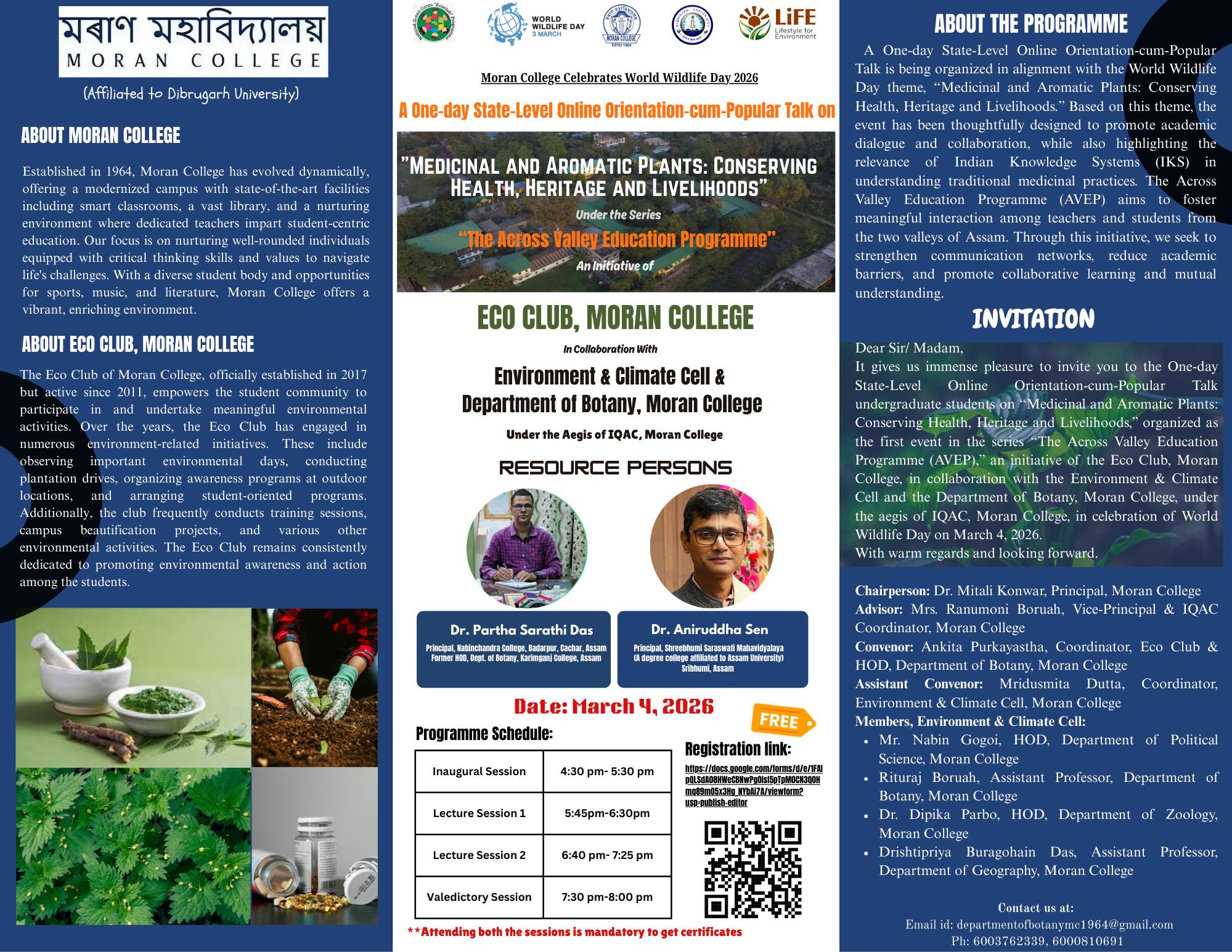
Our students and faculties stand out with exceptional achievements and professional excellence.
No student records found.
The Department follows a strict zero-tolerance policy against ragging as per the guidelines of the University Grants Commission (UGC). Any student experiencing or witnessing ragging (physical, verbal, psychological, or online) should immediately report the matter to:
Complaints may be submitted in writing or via the official helpdesk email. All complaints will be treated confidentially, and strict disciplinary action will be taken against offenders.
For all committees Please Visit: Click HereComplaints related to sexual harassment should be submitted to the Internal Complaints Committee (ICC) constituted under the Sexual Harassment of Women at Workplace (Prevention, Prohibition and Redressal) Act, 2013.
The identity of the complainant will be kept strictly confidential, and due process will be followed as per legal provisions.
For all committees Please Visit: Click HereStudents facing issues related to attendance, internal assessment, examinations, facilities, or other departmental matters may approach:
Written complaints may also be submitted through the official department helpdesk email. The department ensures timely and transparent resolution of grievances.
For all committees Please Visit: Click Here
Site Map
Contact Directory
Feedback
FAQ
NIRF Report
Women’s Cell
Photo Gallery
College Prospectus
Moranhat, Charaideo, Assam, PIN-785670
03754-226179, 229057
principal@morancollege.com
© Copyright 2020 Moran College. All rights reserved. Designed, Developed & Managed by Dr. Pragyan Phukan